
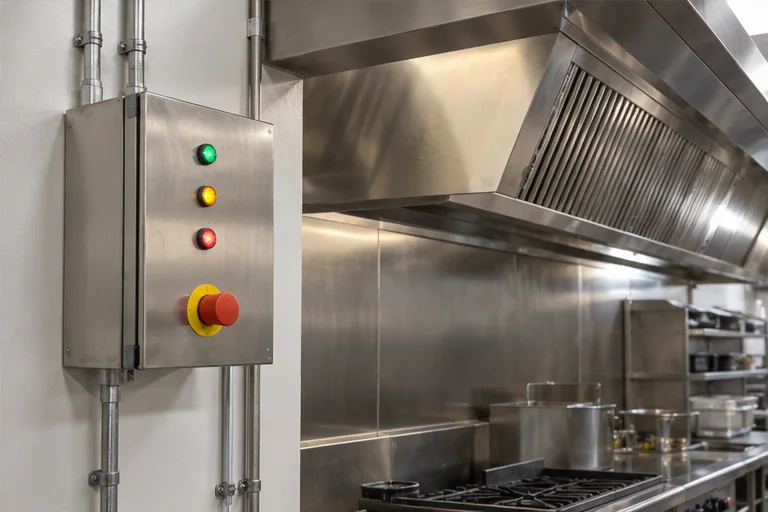
What Does a Kitchen Gas Interlock Do?
An interlock links appliance gas availability to the conditions the system is designed to monitor. In a mechanically ventilated kitchen, that can include evidence that the ventilation is operating.
The design needs to consider the actual appliances and ventilation system. Have an appropriately qualified person assess the installation and explain the panel’s indications using its manufacturer’s instructions.
If the enquiry forms part of wider heating or gas works, our plant room page explains survey and coordination information to gather.
Detection and Shut-Off Are Different Functions
A gas detector monitors a particular gas or condition specified for that device. An automatic shut-off valve controls gas flow when the system gives the relevant signal. Their compatibility and operation depend on the installation design.
A combustible-gas detector should not be assumed to detect carbon monoxide, and a carbon monoxide detector should not be assumed to detect a fuel-gas escape. Identify the equipment actually installed and the function it is intended to perform.
Describe the Existing Equipment
Give the panel or detector make and model where known, the indication displayed and the circumstances of a shutdown. Explain whether the extract system starts, whether appliances remain unavailable and whether other work has recently changed the kitchen.
BS 6173 and Catering Ventilation
HSE’s catering gas safety guidance discusses BS 6173 alongside ventilation and interlocking. The Health and Safety Executive’s catering gas guidance (hse.gov.uk) discusses the standard’s ventilation and interlocking context.
A standard describes agreed practice and is not itself a statement of law. The appropriate assessment must consider the installation and its circumstances, rather than treating a standard name as proof of blanket compliance.
Discuss the applicable requirements and the basis for the proposed arrangement with Commercial Gas Belfast.
Investigate Trips Without Bypassing Protection
Ventilation-system failure can cause appliance shutdown. Have an appropriately qualified person investigate repeated trips.
Do not bridge an interlock or defeat an automatic shut-off to keep appliances operating. If the installation is suspected to be unsafe, follow the building’s emergency arrangements and seek the appropriate qualified assistance.
Keep the Three Functions Distinct
Ventilation interlocking concerns an operating condition, detection concerns a specified gas or monitored condition, and a shut-off valve controls the gas supply when signalled. An installation can combine these functions, but its specification must identify which conditions are monitored and which outputs act on the supply.
Manufacturer information is useful here: the panel, connected detectors and valve need to be identified as part of the actual installation. Discuss the indications and control functions with Commercial Gas Belfast using that information, alongside the appliances and ventilation arrangement.
Kitchen Changes Need a Connected Assessment
Describe the appliances, ventilation arrangement and intended kitchen use to the appropriately qualified person assessing the installation. Include any changes proposed for the kitchen.
Include the opening hours, the time available for work and the person coordinating kitchen and ventilation contractors. Planned work should account for how the kitchen returns to operation and what handover information its staff need.
The commercial sectors page covers hospitality premises alongside education, leisure and other occupied buildings.
Discuss the Control Requirement
Discuss the interlock, detection and shut-off functions needed for your kitchen with Commercial Gas Belfast.
Use the interlock and detection enquiry to begin a discussion about the system. Gas Safe registration and the relevant commercial catering competence should be checked before gas work is commissioned.